
Board and Care Homes vs Large Communities in San Diego: An Honest Comparison
Quick answer: In San Diego, six-bed board and care homes typically cost $5,500 to $9,500 monthly, while larger assisted...


When a parent or spouse is diagnosed with Alzheimer’s or another dementia, one of the first things families notice is that conversations stop working the way they used to. Questions get repeated. Stories get mixed up. A simple request turns into an argument. Communicating with a loved one who has dementia is a skill, and like any skill it can be learned.
The good news is that meaningful conversation and connection remain possible at every stage of the disease. This guide shares 9 practical tips for communicating with a loved one who has dementia, what to say in the hardest moments, how communication changes from early to late stage, and how the right care setting, whether at home, in a board and care home or in memory care, can make daily communication easier for everyone.
Dementia affects the parts of the brain that handle short-term memory, language, attention and judgment. Your loved one may lose track of a sentence halfway through, struggle to find a word, or forget what you said a minute ago. Long-term memories, emotions and personality often last much longer than recent memory, which is why a parent who cannot remember breakfast may still sing every word of a song from 1965.
It helps to remember that the person is not being difficult on purpose. When communication breaks down, it is usually because the brain is getting more information than it can process at once. Most of the tips below come down to one idea: make it easier for the brain to keep up, and focus on how your loved one feels rather than on getting the facts right.
1. Do not depersonalize your loved one. Resist the urge to believe your loved one’s identity is being erased as the disease progresses. Even a person with advanced dementia keeps core parts of their personality, beliefs, likes and dislikes. A lifelong teacher may still light up when asked for advice. A former Navy sailor may still stand a little straighter when someone mentions his ship.
Keep talking about the things that make your loved one who they are, and keep helping them reconnect with those parts of themselves. Talk with them, not about them, especially when others are in the room.
2. Do not try to correct inaccuracies. Inaccurate statements are a normal part of life with dementia. If your mother says she spoke with her sister this morning, and her sister passed away years ago, correcting her usually leads to fresh grief or an argument she cannot win.
Instead, live in your loved one’s world in the moment. Respond to the feeling behind the words: “You must miss her. Tell me about her.” Be patient with repeated questions, even if it means giving the same answer many times. Arguing over facts tends to frustrate and frighten a person with dementia, and it rarely changes what they believe.
3. Keep the brain engaged, gently. People with dementia still benefit from conversation, music, simple tasks and time with others. Keep your loved one engaged without overloading them. Signs you are doing too much include fidgeting, pacing, irritability or suddenly going quiet. Short, pleasant activities beat long ones. Our guide to helpful dementia activities for caregivers has ideas for each stage.
4. Minimize distractions. A person with dementia can become agitated by too much noise or movement. Turn off the TV, step away from a busy kitchen, and sit somewhere quiet before an important conversation. Many families find that this alone makes a big difference, especially in later stages, when a calm, familiar setting matters more than ever.
5. Do not infantilize the person. You are speaking to an adult with a lifetime of experience. Avoid baby talk, a sing-song voice or calling your parent “sweetie” if that is not how you have always spoken. Simple words are fine. Childish ones are not. Treating your loved one with dignity also tends to bring out their best behavior.
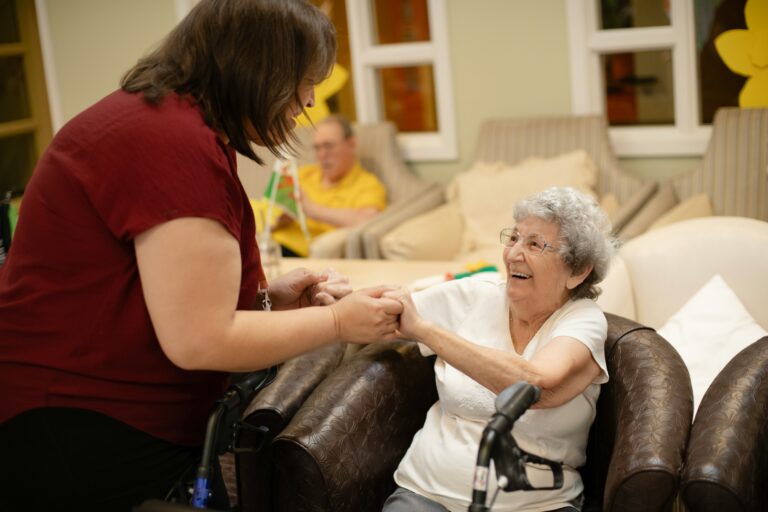
6. Speak and act calmly. People with dementia often read emotions better than words. If you seem rushed or upset, your loved one may mirror that feeling and become upset too. Slow down, lower your voice, smile and make eye contact at eye level. Approach from the front so you do not startle them, and say your name if they may not recognize you right away.
7. Keep it to one topic and one step at a time. Following several threads of conversation is hard for anyone, and very hard with dementia. Stick to one subject. Give one instruction at a time (“Let’s put your arm in this sleeve”) rather than a list. Ask yes-or-no questions or offer two choices (“Would you like the blue sweater or the red one?”) instead of open questions like “What do you want to wear?”
8. Give time to respond. Processing words takes longer with dementia. After you ask something, count silently to 10 before repeating it. If you need to repeat, use the same words rather than rephrasing, so your loved one does not have to start over with a new sentence. Resist finishing their sentences unless they clearly want help.
9. Do not respond to aggression with aggression. Periods of anger or aggression are among the hardest parts of caring for someone with dementia. You may feel hurt, frustrated or scared. Try to remember that the behavior is not who your loved one is. It is usually a reaction to fear, pain, confusion or an unmet need.
Step back, physically and mentally, and look for the cause. Is your loved one hungry, tired, in pain, needing the bathroom, too hot or cold, or overwhelmed? Change the setting or the subject and see whether things calm down. Keep a simple log of what happens before outbursts so you can avoid those triggers. If you ever fear for your safety or your loved one’s safety, call for help, and talk with their doctor, because new or worsening aggression can have a medical cause such as a urinary tract infection or a medication side effect.
Certain situations come up again and again in dementia care. Having a few responses ready makes them easier to handle with patience.
“I want to go home.” This is often said even when your loved one is at home. “Home” usually means a feeling of safety and comfort. Try: “You’re safe here with me. Tell me about your home.” A warm drink, a favorite blanket or a short walk can help more than any explanation.
“Where is my husband?” (when he has died). Telling your parent again that her husband died can make her grieve as if for the first time. Many families gently redirect: “You’re thinking about Dad. What do you miss most about him?” Each family decides what feels right, but the goal is comfort, not a quiz.
“Someone stole my purse.” Accusations of theft are common when people misplace things. Do not argue or take it personally. Say, “That’s upsetting. Let’s look for it together,” and keep a spare of frequently lost items.
Repeated questions. Answer calmly as if it were the first time. For questions about plans, a large-print note or whiteboard (“Lunch with Susan at noon today”) can help.
Refusing care, such as a bath or medication. Back off, wait 15 to 20 minutes and try again, perhaps with a different person or a different approach. Pushing usually leads to a bigger standoff.
Early stage. Your loved one can still hold conversations, make many decisions and express wishes. This is the time to talk about the future: care preferences, finances, legal documents and what kind of senior care home they would want if they could no longer live alone. Include them in decisions, and let them tell you how they want to be helped. Our guide on what to do after a dementia diagnosis walks through those first steps.
Middle stage. Word-finding problems, confusion about time and place, and repeated questions become common. Shorter sentences, choices instead of open questions, and lots of reassurance help. This is often when caregiving at home becomes exhausting, and when sundowning, the late-afternoon restlessness many people with dementia experience, starts to shape the day.
Late stage. Your loved one may speak very little or not at all. Communication becomes mostly nonverbal: touch, tone of voice, facial expression, music and your presence. Hold hands, play favorite songs, read aloud, or simply sit together. People in late-stage dementia often still respond to a familiar voice and a gentle touch, even when they cannot answer.
As words become harder, body language carries more of the message in both directions.
Where your loved one lives makes a real difference in how well communication works day to day. In a large, busy community, rotating staff and noisy common areas can leave a person with dementia confused and on edge. In a small, quiet setting with the same faces every day, many residents become calmer and more talkative.
That is one reason so many San Diego families choose board and care homes in San Diego for a parent with dementia. A licensed home with about 6 residents usually has the same few caregivers every day. Those caregivers learn your loved one’s history, cues and favorite topics, and they notice changes quickly. For residents who wander or need a secured building, dedicated memory care facilities in San Diego train staff specifically in dementia communication and behavior.
When you tour any residential senior care option, listen to how caregivers speak to residents. Do they approach from the front, use names, kneel to eye level and give people time to answer? Do they redirect gently rather than argue? Those small habits tell you more than any brochure.
Patient communication is much easier when you are rested. Constant repeated questions, accusations and night waking wear down even the most loving family caregiver. If you find yourself snapping or dreading conversations, that is a sign you need more support, not a sign you are failing.
Options include adult day programs, in-home help, support groups and respite stays. See our guides to caregiver support in San Diego and memory day care. The Alzheimer’s Association also runs a free 24/7 Helpline at 800-272-3900 for caregivers who need advice in the moment.
When communication breakdowns, wandering or caregiver exhaustion make home care too hard, Elder Answers can help you find the right senior care home. Our advisors personally visit the board and care homes and memory care communities we recommend, and we know which ones have caregivers skilled in dementia communication.
Our senior care placement help is free. We are paid by the care home after move-in, and the rate you pay does not change. We share your family’s information only with the homes you choose. Contact Elder Answers to talk with a local advisor.
Usually not. Correcting someone with dementia rarely changes what they believe and often causes frustration or fresh grief. Respond to the feeling behind the words instead, and save corrections for true safety issues.
Many dementia care experts support “therapeutic fibbing” or gentle redirection when the truth would only cause distress, such as repeatedly hearing that a spouse has died. The goal is comfort and safety, not deception for convenience. Each family should decide what feels right for their loved one.
Answer calmly each time as if it were the first. Notes, a whiteboard or a large calendar can help for questions about plans. Repeated questions often signal anxiety, so reassurance may help more than information.
Help can feel like a loss of control. Offer choices, explain one step at a time, and let your loved one do as much as they can. Also check for pain, hunger, fatigue or an infection, since sudden changes in behavior can have a medical cause.
Rely on touch, tone of voice, music and presence. Holding hands, reading aloud or playing favorite songs can still bring comfort. Watch facial expressions and body movement for signs of pain or distress.
Choose a calm time of day, keep it short, and focus on safety and comfort rather than losses. In early stages, involve your loved one in touring and choosing. In later stages, families often decide together with the doctor and focus on making the transition as calm as possible.
Yes. Many board and care homes in San Diego specialize in dementia care, and the small setting with consistent caregivers often makes communication easier. Seniors who wander or try to leave may need a secured memory care setting instead.
The Alzheimer’s Association offers a free 24/7 Helpline, education classes and support groups. Local adult day programs and caregiver resource centers also help. Elder Answers can help when it is time to look at a senior care home.
When you adjust the way you communicate, you can keep having meaningful moments with your loved one who has dementia, and you protect the emotional bond you have always shared. You will not get every conversation right, and that is okay. Calm, patience and kindness count far more than perfect words.
Quick answer: In San Diego, six-bed board and care homes typically cost $5,500 to $9,500 monthly, while larger assisted...
The first question most families ask when a parent needs more help is simple: what will this cost? In...
When a parent can no longer live safely alone, most San Diego families start by searching for assisted living....

Finding assisted living for a parent or loved one can feel overwhelming. You're navigating unfamiliar terminology, comparing costs across...