
Home Health in Assisted Living: Does Medicare Cover It?
Quick answer: Yes. Medicare home health in assisted living is covered when a resident is homebound, needs intermittent skilled...


One of the first questions families ask when exploring senior care is: how much does it cost, and how do we pay for it? Whether you are considering a board and care home, assisted living community, or memory care facility, understanding the financial landscape is critical to making a confident decision for your family.
This guide covers the real costs of senior care homes in 2026, the major funding sources available to California families, and practical strategies for making care affordable.
The cost of senior care varies based on the type of community, the level of care your parent needs, and the geographic location. Here is a general overview of what families can expect to pay in 2026.
Board and care homes (small residential care facilities for the elderly, or RCFEs, usually serving six or fewer residents) offer personalized care in a home-like setting. In San Diego, board and care homes realistically range from about $5,500 to $9,500 per month, and a private room often adds $1,000 to $2,000 over a shared room. The most important cost drivers are room type (shared vs. private), the home’s location within San Diego County, and — above all — the level of hands-on care your parent requires. A resident with minimal care needs in a shared room may pay closer to the lower end; a resident needing full assistance with all daily activities in a private room will fall toward the higher end of that range.
Most board and care homes use an all-inclusive pricing model: one monthly rate covers housing, meals, personal care, medication management, laundry, and housekeeping. This transparency makes budgeting easier and means families are less likely to encounter surprise add-on charges.
Assisted living communities in San Diego span a wide range, from roughly $5,500 to $12,500 per month, depending on room type, community amenities, neighborhood, and care level. Base rates typically cover housing, meals, and basic services. Additional care is billed separately through a tiered “care level” system, so it is critical to understand what is included versus what costs extra before signing a residency agreement. Our 2026 guide to assisted living costs in San Diego breaks this down further.
Memory care communities in San Diego typically range from about $7,500 to $14,000 per month, reflecting the higher staffing ratios, secured environments, and specialized dementia programming required. Premium coastal communities sit at the top of that range, while small board and care homes that specialize in dementia often run about $6,000 to $9,500. See our overview of memory care facilities in San Diego.
Across all care types, the level of care your parent needs is consistently the biggest variable in monthly cost. A senior who needs help with one or two activities of daily living will pay meaningfully less than someone who needs round-the-clock hands-on assistance. Room type (shared vs. private), geographic location (coastal vs. inland San Diego), and community amenities also affect pricing significantly.
Most families use a combination of funding sources to pay for senior care. Here are the most common options.
Private pay is the most common way families fund senior care. This includes using your parent’s savings, Social Security income, pension benefits, retirement account withdrawals (IRA, 401k), and any other personal income or assets.
For many families, private pay is supplemented by other funding sources listed below. A financial advisor who specializes in elder care can help you create a sustainable payment plan.
Medi-Cal is California’s Medicaid program, and it is one of the most important funding sources for lower-income seniors who need care.
What Medi-Cal Covers for Board and Care: Medi-Cal’s Supplemental Security Income/State Supplementary Payment (SSI/SSP) program provides a monthly benefit to eligible seniors that many board and care homes accept as full or partial payment. In 2026, the SSI/SSP payment standard for an individual living in a licensed board and care home is approximately $1,626 per month. While this does not cover the full cost of most homes, some board and care operators accept this amount, particularly when supplemented by the resident’s other income.
Assisted Living Waiver (ALW) Program: California’s ALW program allows eligible Medi-Cal beneficiaries to receive assisted living services in participating communities. The program covers personal care, meals, and other services but not room and board. The ALW program has limited capacity and a waitlist in many counties, but it is an important resource for families who qualify.
Medi-Cal Eligibility: To qualify for Medi-Cal, your parent must meet income and asset limits. Starting January 1, 2026, California reinstated a Medi-Cal asset limit of about $130,000 for an individual and $195,000 for a couple. See our Medi-Cal eligibility guide for details. Medi-Cal planning with an elder law attorney can help families understand what counts as a countable asset and what strategies are available.
The VA Aid and Attendance benefit is a monthly supplement available to wartime veterans and their surviving spouses who need help with activities of daily living or who are housebound. This benefit can be used to help pay for board and care, assisted living, or memory care.
For December 2025 through November 2026, the maximum pension with Aid and Attendance is approximately $2,424 a month for a single veteran, $1,558 for a surviving spouse, and $2,874 for a veteran with one dependent. These are maximum rates that already include the basic VA pension, and the actual payment is reduced by countable income. Our guide to veterans assisted living explains eligibility.
To qualify, the veteran must have served at least 90 days of active duty, with at least one day during a wartime period, and have been discharged under conditions other than dishonorable. The veteran or surviving spouse must also demonstrate a medical need for assistance with daily living.
The application process can take several months. Working with a VA-accredited claims agent or an elder law attorney who specializes in VA benefits can help ensure the application is complete and processed efficiently.
If your parent purchased a long-term care (LTC) insurance policy, it may cover part or all of the cost of a senior care home. LTC policies vary widely, but most pay a daily or monthly benefit amount after a waiting period (called an elimination period) of 30 to 90 days.
Key things to check in your parent’s LTC policy include the daily benefit amount, the benefit period (how long the policy will pay), the elimination period, inflation protection, and what types of care facilities are covered. Some older policies may not cover board and care homes or may have restrictive definitions of qualifying care.
If your parent has an LTC policy, contact the insurance company early in the process to understand the claims procedure and required documentation.
For seniors who own their home, the equity in that property can be a significant source of funding for care.
Selling the Home: If your parent is moving permanently into a senior care home, selling their house can free up substantial funds. The proceeds can be invested conservatively and drawn down to cover monthly care costs.
Reverse Mortgage: A Home Equity Conversion Mortgage (HECM) allows homeowners aged 62 and older to convert part of their home equity into cash without selling the home. The loan does not need to be repaid until the homeowner moves out, sells the home, or passes away. Reverse mortgages can provide a lump sum, monthly payments, or a line of credit.
Home Equity Line of Credit (HELOC): A HELOC allows homeowners to borrow against their home equity as needed. This can be a flexible short-term option while other funding sources are being arranged.
Some families need to fund care immediately while waiting for a home to sell, an insurance claim to process, or a VA benefit to be approved. Bridge loans specifically designed for senior care can provide short-term funding to cover this gap. These loans are typically repaid when the home sells or the insurance or VA benefits begin.
Some life insurance policies can be converted into cash to pay for senior care. Options include cashing out the policy’s surrender value, taking a policy loan, or using a life settlement (selling the policy to a third party for a lump sum). An elder law attorney or financial advisor can help evaluate whether this makes sense for your family.
The most effective approach for most families involves combining multiple funding sources. Here is a simple framework for building a financial plan.
Calculate the monthly care cost. Get quotes from the communities you are considering and understand exactly what is included and what costs extra.
Add up all income sources. Include Social Security, pensions, rental income, investment income, VA benefits, and any LTC insurance benefits.
Identify the monthly gap. Subtract your parent’s total monthly income from the monthly care cost. The difference is the amount you need to cover from savings, home equity, or other assets.
Estimate how long savings will last. Divide your parent’s available assets by the monthly gap to estimate how many months or years of care can be funded.
Consult an elder law attorney. If your parent may need Medi-Cal now or in the future, consult an attorney who specializes in elder law and Medi-Cal planning. Proper planning can protect assets and ensure eligibility.
At Elder Answers, we understand that the financial aspect of senior care is often the most stressful part of the process. While we are not financial advisors, our placement advisors help families understand the cost landscape, identify communities that fit their budget, and connect families with elder law attorneys, VA benefits specialists, and financial professionals who can help.
Our placement service is completely free for families. We work with board and care homes and assisted living communities of all price points throughout San Diego County.
In San Diego, costs realistically range from approximately $5,500 to $14,000 per month across all senior care types. Board and care homes generally range from $5,500 to $9,500 per month with all-inclusive pricing. Assisted living communities range from $5,500 to $12,500 per month depending on room type, location, and care level. Memory care typically runs $7,500 to $14,000 per month. Level of care is the biggest driver of cost within any given community.
The SSI/SSP program (separate from Medi-Cal, but often paired with it) provides a monthly benefit of roughly $1,626 in 2026 that some board and care homes accept as payment, usually for a shared room. California’s Assisted Living Waiver program may also help cover services for eligible Medi-Cal beneficiaries.
VA Aid and Attendance is a monthly supplement for wartime veterans and surviving spouses who need help with daily living. It can provide up to approximately $2,424 per month for a single veteran and can be used to pay for assisted living or board and care.
Many LTC policies cover board and care homes, but coverage varies by policy. Check your parent’s policy for benefit amounts, covered facility types, elimination periods, and claims procedures.
Options include Medi-Cal (SSI/SSP for board and care), the VA Aid and Attendance benefit, selling or borrowing against a home, life insurance conversions, and family contributions. An elder law attorney can help identify all available resources.
Yes. While we are not financial advisors, we help families understand care costs, find communities that fit their budget, and connect them with elder law attorneys and financial professionals. Our placement services are always free.
Ask an Elder Answers advisor about financial options — free guidance. Visit elder-answers.com or call us today.
Quick answer: Yes. Medicare home health in assisted living is covered when a resident is homebound, needs intermittent skilled...
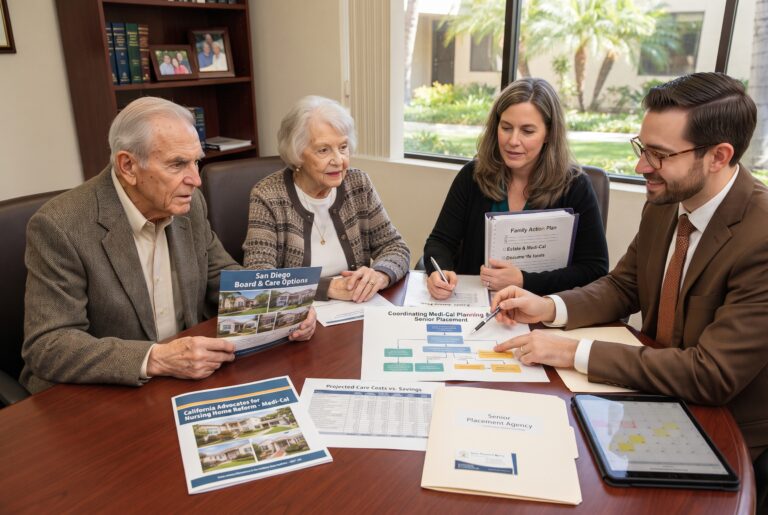
Quick answer: Elder law Medi-Cal planning and assisted living placement work best when coordinated. Because Medi-Cal does not pay...

Quick answer: Many San Diego board and care homes and assisted living communities have caregivers who speak Spanish, Tagalog,...

Quick answer: LGBTQ+ senior living in San Diego should feel safe, affirming and respectful. California law protects LGBTQ+ residents...