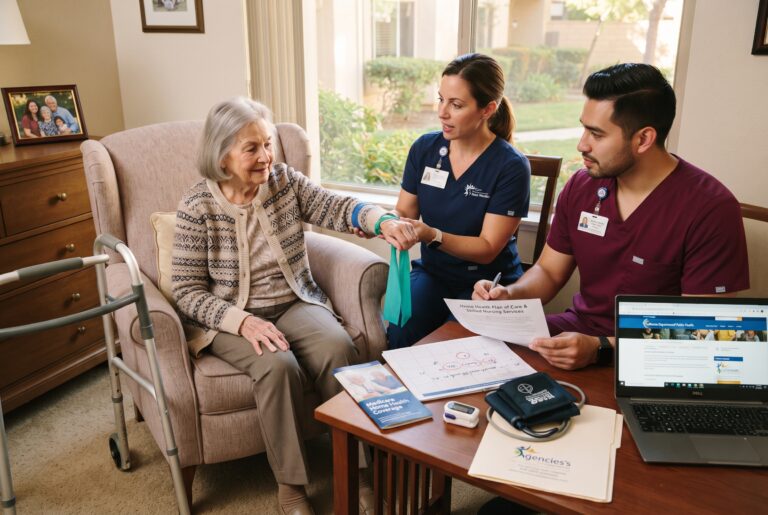
Home Health in Assisted Living: Does Medicare Cover It?
Quick answer: Yes. Medicare home health in assisted living is covered when a resident is homebound, needs intermittent skilled...


Many widows and widowers of wartime veterans do not know they may qualify for a monthly VA payment that can help cover the cost of a board and care home or assisted living. The VA Survivors Pension, especially with the Aid and Attendance add-on, is designed for lower-income surviving spouses, but because care costs can be counted against income, it often helps families who would not expect to qualify. For a surviving spouse moving into residential senior care, VA survivors pension assisted living benefits can make a real difference to the monthly budget.
This guide explains who qualifies for the VA Survivors Pension, the current 2026 rates, how care home costs affect eligibility, how to apply, and how families in San Diego County can get free help with the paperwork. All figures come from va.gov and apply from December 1, 2025, through November 30, 2026.
The VA Survivors Pension is a tax-free monthly payment for low-income surviving spouses and unmarried children of wartime veterans. It is separate from Dependency and Indemnity Compensation (DIC), which is for survivors of veterans who died from service-connected causes. Surviving spouses who need help with daily activities can receive a higher rate called Aid and Attendance.
There are three levels of the Survivors Pension for a surviving spouse:
For most surviving spouses moving into a board and care home or assisted living, Aid and Attendance is the relevant level. Our broader guide to veterans assisted living benefits covers the veteran’s own pension and other VA programs.
To qualify, the surviving spouse must not have remarried, must meet VA marriage and cohabitation rules, must have income and net worth within the limits Congress sets, and the deceased veteran must have had qualifying wartime service and a discharge other than dishonorable.
The veteran’s service. At least one of these must be true:
Recognized wartime periods include World War II (December 7, 1941 to December 31, 1946), the Korean conflict (June 27, 1950 to January 31, 1955), the Vietnam era (November 1, 1955 to May 7, 1975 for those who served in-country, and August 5, 1964 to May 7, 1975 for others) and the Gulf War (August 2, 1990 to a future date set by law). The veteran did not need to serve in combat.
The surviving spouse.
For a surviving spouse with no dependent children, the VA’s maximum annual pension rates (MAPR) effective December 1, 2025, are $11,699 for the basic pension, $14,298 for Housebound and $18,697 for Aid and Attendance. That is roughly $975, $1,192 and $1,558 a month. The actual payment is the MAPR minus countable income.
Surviving spouse, no dependents (annual MAPR from December 1, 2025):
These rates reflect the 2.8 percent cost-of-living increase that took effect December 1, 2025. Rates are higher for surviving spouses with dependent children. Always check the current table on va.gov, because rates are adjusted each December.
The VA subtracts unreimbursed medical expenses above 5 percent of the MAPR from a survivor’s income. When a surviving spouse needs help with daily activities and lives in a licensed care home, much of the monthly cost can count as a medical expense. That can lower countable income to zero, which is why VA survivors pension assisted living benefits help people whose income looks too high at first glance.
How the math works, in simple terms:
Illustrative example (hypothetical): A surviving spouse in La Mesa receives $2,000 a month from Social Security ($24,000 a year) and moves into a board and care home costing $6,500 a month ($78,000 a year). If she qualifies for Aid and Attendance and the VA accepts the care home cost as a medical expense, her deductible medical expenses ($78,000 minus $584) exceed her income. Her countable income becomes zero, and she could receive the full Aid and Attendance rate of $18,697 a year, about $1,558 a month. Actual results depend on VA review of each case.
Board and care homes in San Diego typically cost about $5,500 to $9,500 a month in 2026, and assisted living about $5,500 to $12,500. For many surviving spouses, the pension does not cover the full cost, but it can close a meaningful part of the gap. To see what a monthly rate usually includes, read what’s included in a board and care monthly rate.
For December 1, 2025, through November 30, 2026, the VA net worth limit is $163,699. Net worth includes assets plus yearly income, but not the primary home, a vehicle or most household furnishings. The VA also reviews assets transferred for less than fair value in the three years before applying, which can lead to a penalty period.
What families should know:
If you are deciding whether to sell a parent’s home, consider how that affects both VA and Medi-Cal eligibility before you list it.
Surviving spouses apply using VA Form 21P-534EZ, the application for DIC, Survivors Pension and accrued benefits. For Aid and Attendance, the VA also needs medical evidence of the need for help, usually on VA Form 21-2680 completed by a doctor. Filing an intent to file first can protect an earlier start date.
Steps to apply:
Processing can take months. Many families pay the care home privately while the claim is pending, and benefits may be paid back to the effective date once approved.
You do not need to pay anyone to apply for VA benefits. San Diego County’s Office of Military and Veterans Affairs offers free help with VA claims, and accredited veterans service organizations can also help. Be cautious of anyone who charges to fill out the application or promises to “reposition” assets.
Where to get help:
Military families in San Diego have other options too. Our guide to senior care for military families near Camp Pendleton and Naval Base San Diego covers local resources, and our article on VA medical foster homes in San Diego explains another VA-linked care option.
The VA Survivors Pension is paid to the surviving spouse, not the care home, and can be used toward any care setting. For many widows and widowers, a small board and care home is a good match: personal care is included in one monthly rate, and costs are often lower than assisted living for someone who needs a lot of help.
Things to consider when choosing a home:
If budget is tight even with VA help, our guide to low-income senior care options in San Diego County lists other programs.
Elder Answers helps surviving spouses and their families find senior care homes that fit both care needs and budget. We have helped San Diego families for well over a decade, and our advisors personally visit the homes we recommend. We are not VA representatives, but we can point you to free help with the claim.
Our help is free for families because homes pay us after a move-in, and your rate does not change. We share your information only with homes you choose. Contact Elder Answers to talk about board and care and assisted living options for a veteran’s surviving spouse.
Yes, if she qualifies for the VA Survivors Pension. The Aid and Attendance level is for surviving spouses who need help with daily activities, and care home costs can often be deducted from income as medical expenses, which can increase the payment.
For a surviving spouse with no dependents, the maximum annual rate effective December 1, 2025, is $18,697, about $1,558 a month. The actual payment is that amount minus countable income after medical expense deductions.
From December 1, 2025, to November 30, 2026, the net worth limit is $163,699. Net worth includes assets and yearly income but excludes the primary home, a vehicle and most household items.
No. The veteran must have served during a recognized wartime period and meet minimum service and discharge requirements, but combat service is not required.
Generally, no. The VA requires that the surviving spouse not have remarried after the veteran’s death. A veterans service representative can review specific situations.
No. The pension is paid to the surviving spouse, who uses it toward care costs. The surviving spouse or family then pays the care home.
Processing often takes several months. Filing an intent to file early can protect an earlier effective date, and approved benefits may be paid back to that date.
The County of San Diego Office of Military and Veterans Affairs helps veterans and survivors file VA claims at no cost. Accredited veterans service organizations can also help. Avoid paying anyone simply to complete the application.
Quick answer: Yes. Medicare home health in assisted living is covered when a resident is homebound, needs intermittent skilled...
Quick answer: Elder law Medi-Cal planning and assisted living placement work best when coordinated. Because Medi-Cal does not pay...

Quick answer: Many San Diego board and care homes and assisted living communities have caregivers who speak Spanish, Tagalog,...

Quick answer: LGBTQ+ senior living in San Diego should feel safe, affirming and respectful. California law protects LGBTQ+ residents...